Entrepreneurial Apron Seller Ebenezer Hutchinson of Quechee, Vermont
 As a young man New Hampshire native Ebenezer Hutchinson (1787-1855) pursued a career as a potter. By 1815 he was working with his brothers in Quechee, a village in Hartford, Vermont. There they sold “Brown Earthenware” including sap pots, vessels designed to be used to harvest sap to make maple syrup.
Ebenezer Hutchinson explored a range of business pursuits. In 1820 he advertised that he published a map of New England, sold The New England Farmer’s Diary and Almanac and produced in his own factory hair combs “of every kind and quality, made in the newest fashion.” Adding to the list of the variety of services and products he offered to customers Hutchinson advertised that “he carries on the business of Copper-plate Engraving, & Copper-plate Printing,” employing “the most experienced workmen.”
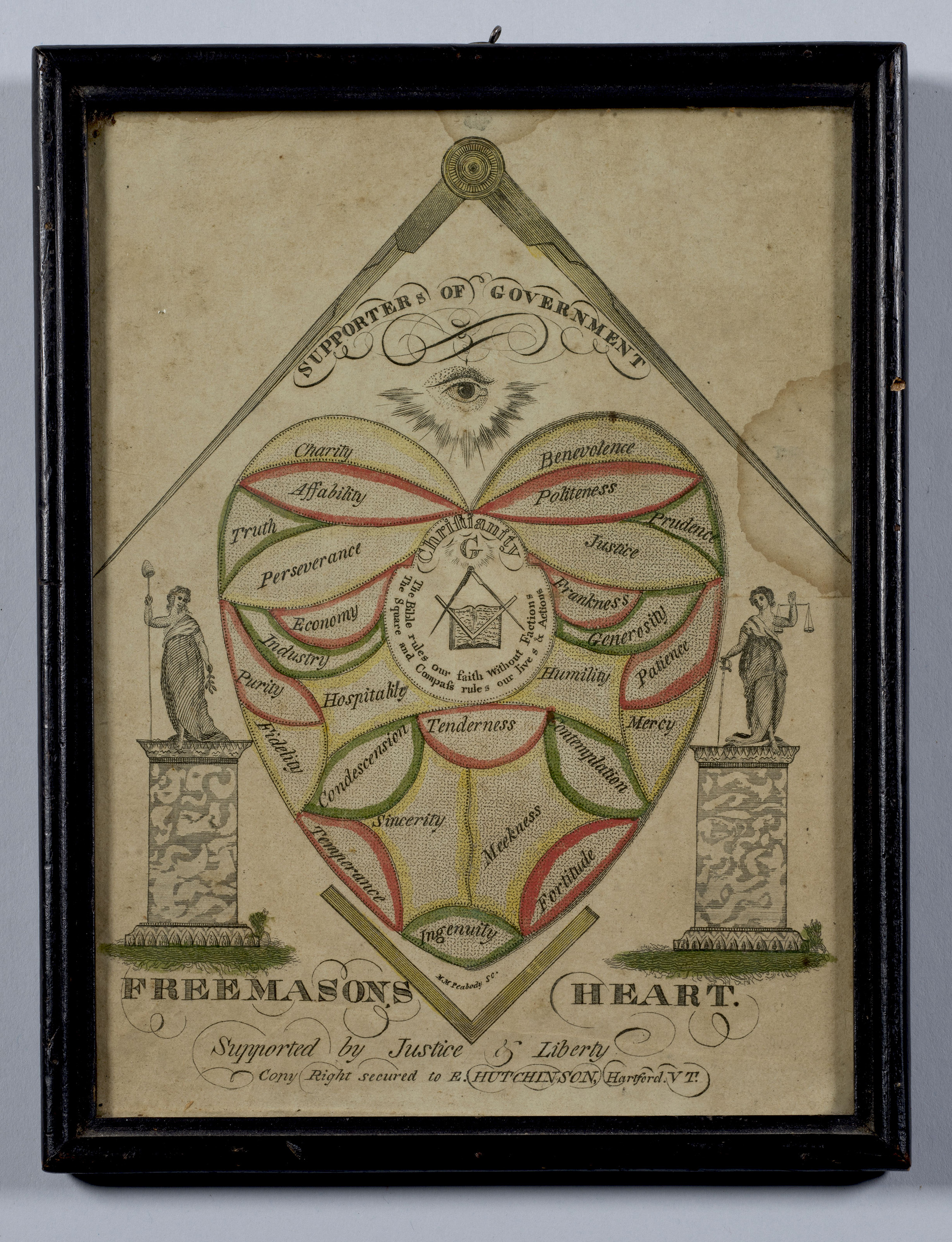
Connected to this business, Hutchinson sold “Masonic Aprons & Diplomas, designed and engraved by Moody M. Peabody of Hartford VT….” Peabody advertised as an engraver in Quechee from June of 1820 through November of 1822, promising to undertake work “in an easy and genteel manner, with dispatch and on reasonable terms.” Hutchinson likely printed the aprons and diplomas Peabody designed. Described as a “Royal Arch Apron” beneath the central design, another inscription on this apron says it was “Printed and Sold by E. Hutchinson Harford queechy village VT. Copy Right Secured.”
An enthusiastic marketer, Hutchinson spoke highly of the aprons and diplomas he offered, claiming that they had “been pronounced by various lodges in Vermont and N. Hampshire, to be superior, both in the design and execution, to any before invented.” Reaching out to a broad audience, he offered his work to Freemasons across the country, stating that “Gentlemen of the craft wishing Aprons or Diplomas, or both, can by addressing a line to the subscriber, have them sent to any part of the United States.”
Hutchinson does not name his potential Masonic customers as brothers, nor does he sign this apron using the title of brother, suggesting that he himself may not have been a Freemason. Records of Masonic membership in the early 1800s are spotty, but Hutchinson is not listed as a member of a lodge in records compiled by the Grand Lodge of Vermont.
Interestingly, several copies of a print, Freemason’s Heart, that Hutchinson and Peabody had collaborated on, such as this one in the museum’s collection, have survived to the present day. Aprons associated with the pair may not have been made in as significant numbers. This one is rare example of regalia signed by Hutchinson.
In spite of—or perhaps because of—his diverse commercial undertakings, Hutchinson ran into financial trouble. In 1823 he listed a large number of items at public auction, being sold “to keep him from prison.” Offerings included household furnishings, such as tables and bureaus, and potentially business-related items, like books, paper, and measures. Hutchinson eventually overcame his financial problems. By 1825 he advertised a new location for his copper plate printing business in Woodstock, Vermont. His work as a map publisher continued for the next two decades, but his time creating Masonic prints and regalia, such as this apron, was short-lived.
If you would like to learn more about the Scottish Rite Masonic Museum & Library and its collection, visit srmml.org.


Latest Articles
